
There is a particular kind of loneliness that comes not from being alone, but from being surrounded by people and still missing everything they say. Millions of Indians live with this experience every day — not because they choose isolation, but because untreated hearing loss slowly, quietly dismantles the connective tissue of human relationships.
Hearing loss is rarely treated with the urgency it deserves. On average, people wait seven to ten years from the time they first notice hearing difficulties to the time they seek professional help. During that decade, the social and emotional damage compounds year after year — damage that is entirely preventable.
When Conversation Becomes Work
Listening with hearing loss is exhausting in a way that is difficult to explain to someone who has not experienced it. What hearing people do effortlessly — follow a conversation, catch a joke, participate in group discussion — requires enormous mental effort when hearing is impaired. The brain works overtime, trying to fill in gaps from lip movements, context, and partial sounds. Audiologists call this ‘listening fatigue’, and by the end of a social event, a person with untreated hearing loss is often genuinely depleted.
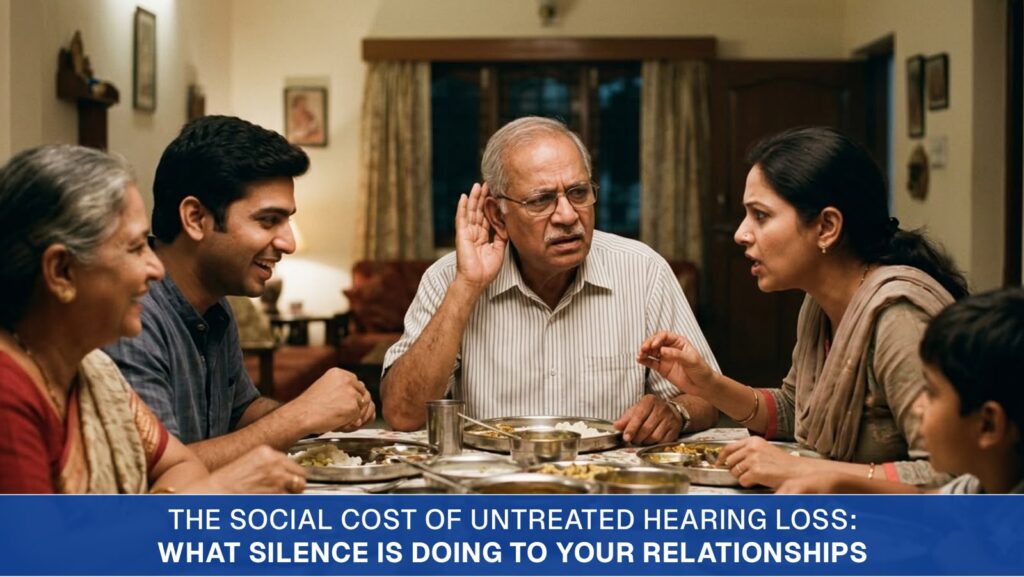
The natural response to this exhaustion is avoidance. Family dinners, weddings, temple gatherings, and office meetings — all the social occasions that weave the fabric of life in Tamil Nadu — gradually become situations to be endured rather than enjoyed. Eventually, many people with untreated hearing loss stop attending altogether. What looks to the family like being anti-social is actually a coping mechanism for a medical condition.
The Strain on Family and Marriage
Hearing loss affects not just the person with the impairment, but everyone around them. Spouses find themselves repeating everything — instructions, news, affectionate exchanges — multiple times, often with increasing frustration. What begins as gentle clarification can erode over years into resentment, as the communication that sustains intimacy gradually breaks down.
Children and grandchildren often adapt their behaviour around an elder with hearing loss, speaking less, simplifying their language, or giving up on sharing the small daily details that form the emotional bond between generations. For the older person, this registers as being left out, as becoming irrelevant, as the world moving on without them. The psychological impact is profound.
Studies consistently show that untreated hearing loss is associated with higher rates of loneliness, anxiety, clinical depression, and even cognitive decline. The brain’s auditory processing centres, starved of stimulation, begin to atrophy. The social withdrawal that accompanies hearing loss removes the mental engagement that keeps the mind sharp. This is not a minor side effect — it is a major, documented pathway to accelerated cognitive ageing.
Professional Consequences That Go Unacknowledged
In the workplace, hearing loss carries a quiet professional toll. Mishearing instructions leads to errors that are attributed to carelessness. Missing key parts of meetings creates the impression of disengagement or incompetence. The effort required to keep up means less cognitive bandwidth for the actual work. Many people with unaddressed hearing loss operate under a constant, invisible handicap — and never connect their professional struggles to the hearing problem that is causing them.
For younger people, this can limit career growth. For those in customer-facing roles, in teaching, in healthcare, or in any profession that depends on clear communication, unaddressed hearing loss is a significant barrier that a proper hearing aid could largely eliminate.
The Transformation That Hearing Aids Bring
The most remarkable part of working in hearing care is witnessing what happens when someone who has struggled for years is finally fitted with the right hearing aid. The transformation is rarely just acoustic — it is emotional and social. People describe hearing their grandchild’s voice clearly for the first time, being able to follow dinner table conversations again, rediscovering the pleasure of music or cinema, feeling present in their own life rather than watching it from a distance.
Modern hearing aids are nothing like the large, whistling devices of the past. Today’s devices are small, discreet, Bluetooth-enabled, and sophisticated. They adapt automatically to different sound environments — quiet conversation, busy restaurant, outdoor gathering — without requiring the wearer to do anything. Many can stream directly from smartphones, televisions, and tablets. The stigma that once surrounded hearing aids has been replaced by technology that rivals any consumer wearable.
Hearing loss does not have to mean withdrawal from life. It does not have to mean strained relationships, professional disadvantage, or the quiet erosion of joy. It is a treatable condition — and treatment works. If you have been putting off a hearing assessment, consider what the delay has already cost, and what you could regain by taking action today.
Sounds Good operates hearing care centres across Madurai, Coimbatore, Tirunelveli, Theni, Tirupur, and Nagarcoil. Our audiologists provide comprehensive hearing evaluations, expert guidance on the right hearing aid for your specific needs and lifestyle, and ongoing support so that you get the most out of every conversation. Book your appointment today — because the sounds of life are worth hearing.